 Guides
Table of Contents
Sooner or later everyone who runs a printer overnight has the same 2 a.m. thought: what is this thing doing to my electric bill? The machine has a heater block at 210C, a bed at 60C, a bank of stepper motors, and it runs for ten hours at a stretch. That sounds expensive. It is not, and we have the meter readings to prove it.
We put a smart plug with power logging on the printers in the lab and ran them through normal jobs: PLA at standard profiles, PETG on the bigger machines, and one deliberately worst-case ABS run in an enclosure with the bed pinned at 100C. Here is what the numbers actually look like as of July 2026, and how to do the same math for your own machine and your own utility rate.
The Headline Numbers
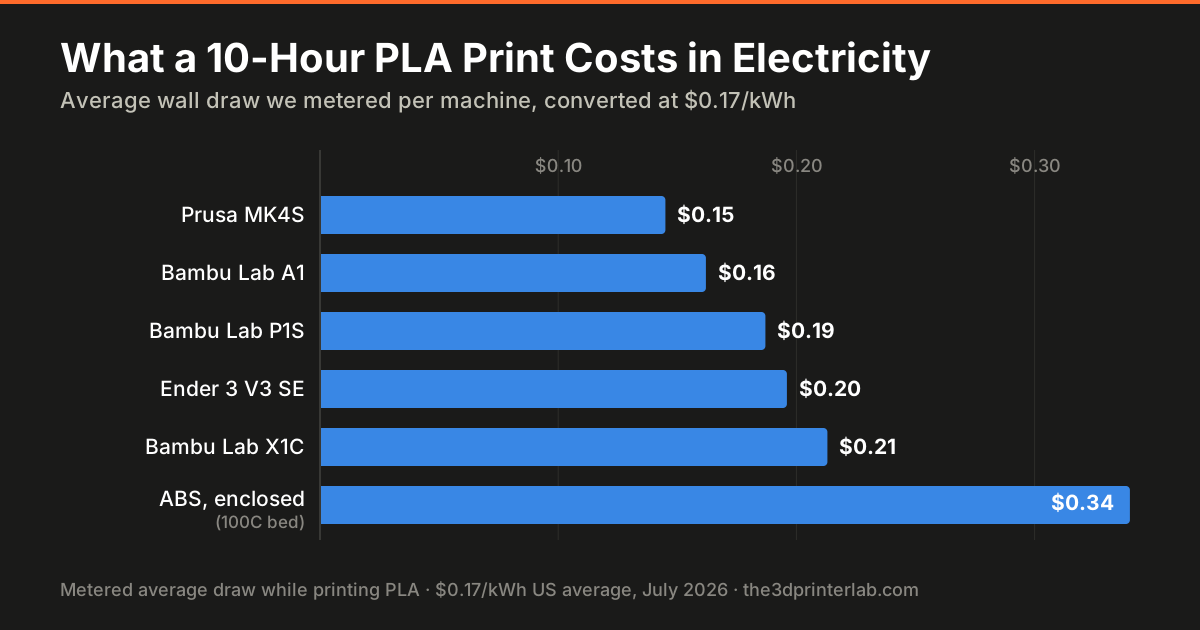
At the mid-2026 US residential average of about $0.17 per kilowatt-hour, a typical 10-hour PLA print costs between 15 and 22 cents in electricity. Not dollars. Cents.
The chart up top breaks that down by machine, but here are the measured averages behind it:
- Prusa MK4S: about 85W average while printing PLA. A 10-hour job is roughly 0.85 kWh, or about $0.15.
- Bambu Lab A1: about 95W average. Call it $0.16 for the same job.
- Bambu Lab P1S: about 110W average with the door open for PLA, roughly $0.19.
- Ender 3 V3 SE: about 115W average. Budget machines are not budget on power; the older heater and bed design run a little less efficiently. About $0.20 per 10-hour print.
- Bambu Lab X1C: about 125W average with the chamber warm, roughly $0.21.
- ABS in an enclosure, 100C bed: this is the outlier at about 200W average, because the bed heater cycles hard the entire job. A 10-hour ABS print runs about $0.34.
The pattern is obvious once you see it: the bed is the whole story. The hotend gets the attention, but a 40W cartridge topping up a small brass block is nothing next to a 220x220mm slab of aluminum being held 40 to 75 degrees above room temperature for ten straight hours.
Where the Watts Actually Go
A printing session has three phases, and they are not close to equal.
Heat-up is the spike. For the first two to four minutes, the machine pulls 350 to 500W while the bed and nozzle climb to temperature. It looks scary on the meter and it is completely irrelevant to the total: even at 500W, four minutes is about 0.03 kWh, or half a cent. Preheating twice because you got distracted before starting the print costs you literally nothing worth counting.
Steady-state printing is the bill. Once temperatures stabilize, the bed heater settles into a duty cycle: full power for a few seconds, off, repeat. On a PLA job at 60C in a normal room, our beds cycled at roughly 30 to 40 percent duty. Steppers, fans, and the mainboard add a surprisingly small floor, 15 to 25W on every machine we metered. Everything above that floor is heaters.
Idle is the part people forget. A printer sitting on but not printing draws 6 to 12W keeping the screen and board alive. Leave it on around the clock and that idle draw adds up to more than a month of actual printing: 10W continuous is about 7.3 kWh a month, or $1.24, versus roughly $2 to $3 for a genuinely heavy month of print jobs. If your machine spends most of its life waiting, a smart plug that cuts power after jobs finish pays for itself on principle alone, and you get the power logging as a bonus.
The Cost Per Spool Framing
Here is the comparison that actually settles the question. Printing through a full 1kg spool of PLA takes most hobby machines somewhere in the 40 to 60 print-hour range across a mix of parts at standard profiles. Split the difference at 50 hours on a 100W-average machine and that is 5 kWh, or about 85 cents of electricity per kilogram of printed parts.
The spool itself cost you $18 to $25. The electricity to turn it into parts is around 4 percent of the material cost. Filament, nozzles, build sheets, and failed prints are your real budget lines; the electrons are a rounding error. If you are choosing between machines, choose on reliability and print quality, not wattage, because the delta between the thriftiest and hungriest PLA machine we metered is about six cents per 10-hour job.
When Electricity Does Start to Matter
There are three honest exceptions to the “it’s a rounding error” rule.
High-temperature materials. Our ABS run averaged 200W, nearly double PLA, and that ratio holds in general: hotter beds and enclosed chambers are the two big multipliers. If you print ABS, ASA, or polycarbonate daily, you are paying roughly 2x the electricity of a PLA user per hour. That is still only about $0.34 per 10-hour job, but a print farm running high-temp material around the clock will notice. On one machine, you will not. If warping is what is pushing you toward a hotter bed in the first place, dial in adhesion before dialing up temperature; our guide to stopping print warping covers the fixes that do not cost watts.
Print farms. Ten machines at 110W each is 1.1 kW continuous, which is 26 kWh a day if they stay busy, about $4.50 daily or $135 a month at average rates. Real money, and also the point where per-machine efficiency and idle cutoff automation stop being trivia.
Expensive electricity. Rates vary wildly by region. At California’s 30-plus cents per kWh, every number in this article roughly doubles; on a cheap fixed-rate plan in the South it shrinks. The formula is simple enough to run yourself: average watts x hours / 1000 x your rate. Your utility bill lists the rate; a $12 metering smart plug gives you the watts.
What About Material Choice?
Material drives the wattage more than the machine does, because material sets the bed temperature. PLA at 55-65C is the efficiency baseline. PETG at 70-85C runs the bed duty cycle noticeably harder; figure 10 to 20 percent more total draw for the same duration. ABS and ASA at 100C-plus in an enclosure are the 2x case. If you are still deciding what to print with, our PETG vs PLA breakdown covers the strength and ease-of-use tradeoffs, and the power difference between those two specifically is small enough that it should not influence the choice.
Resin printers, for what it is worth, sit in the same territory as PLA machines: an LCD unit with a heater averages 60 to 90W. The resin vs FDM decision comes down to detail, cleanup, and safety, not the meter.
How to Meter Your Own Machine
You do not need our numbers; you can have your own by tomorrow morning. Any smart plug with energy monitoring works. Put the plug between the printer and the wall, run a normal print, and read the session kWh off the app when it finishes. Two things to check before you trust it: make sure the plug is rated for at least 10 amps (every plug on the market is fine for a hobby printer, which peaks around 4 amps at 120V, but check anyway), and take the average over a whole print rather than staring at the live wattage, because the bed’s duty cycling makes the instantaneous number bounce between 20W and 400W all job long.
Then it is one line of arithmetic: session kWh x your utility rate x how many prints you actually run a month. For almost everyone, that final number lands somewhere between “a coffee” and “two coffees,” and you can stop wondering.
The Bottom Line
Run the printer. A heavy month of PLA printing, say 120 print hours, is 12 to 15 kWh, roughly $2 to $2.60 at average 2026 rates. Your refrigerator uses about ten times that. The 2 a.m. anxiety is misplaced unless you are running a farm, printing high-temp materials daily, or leaving a dozen machines idling on standby, and in all three cases the fix is a meter and an automation, not a different hobby.
Next time someone tells you 3D printing is expensive, agree with them, then point at the spool rack and the box of spare hotends. The electric company is the one party in this hobby that is barely getting paid.
Sponsored
Ready to Print?
Browse our guides for more tips on getting the best results from your printer.
Browse All GuidesReady to Print?
Browse our guides for more tips, reviews, and step-by-step tutorials to get the most out of your 3D printer.
Browse All Guides