 Guides
Table of Contents
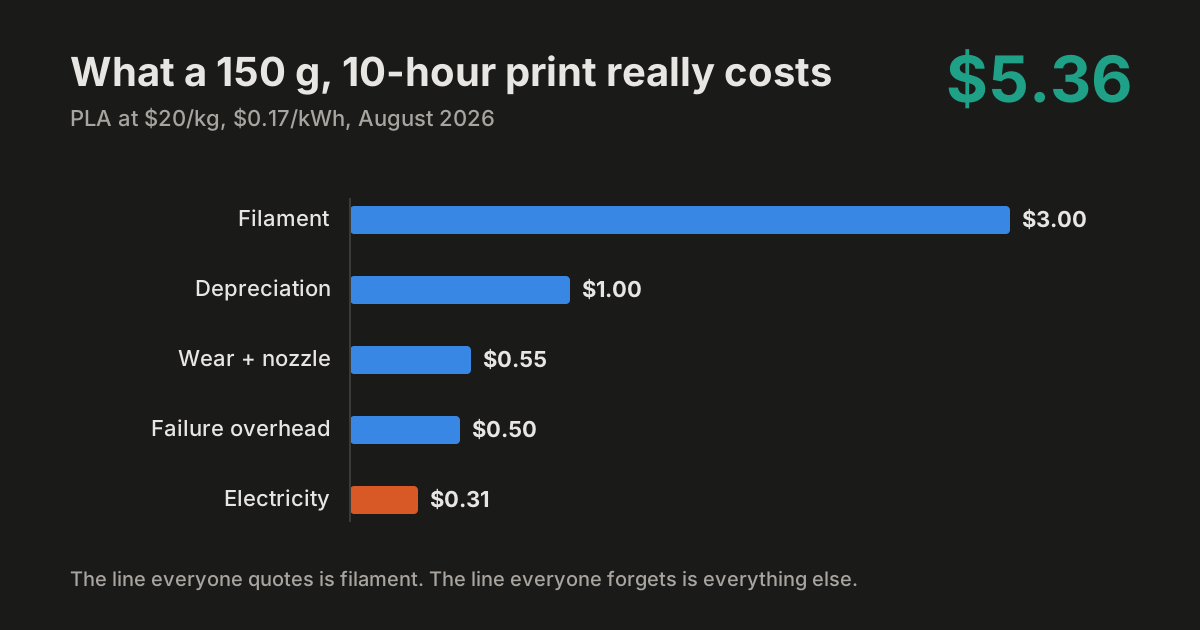
“What did that cost to print?” is the most common question a 3D printer owner gets, and almost everyone answers it wrong. The usual answer is filament-only math: 150 grams at $20 per kilo, “about three bucks.” The real answer includes electricity, nozzle and part wear, failed-print overhead, and the printer slowly consuming itself, and it is still cheap, but it is about 40 to 60 percent more than the filament-only number. If you ever print for other people, that gap is your entire margin.
Here is the full costing on a real 150-gram, 10-hour print, using August 2026 prices, and a simple formula you can reuse.
The Worked Example: 150 Grams, 10 Hours, PLA
Filament: $3.00. Decent-quality PLA has settled around $18 to $22 per kilogram in mid-2026 for the reliable mainstream brands. At $20/kg, 150 grams is $3.00. PETG runs a touch higher ($20 to $28/kg), ABS similar, and TPU still commands $28 to $40/kg. If you are choosing between materials for a job, our PETG vs PLA guide covers when the upgrade earns its cost.
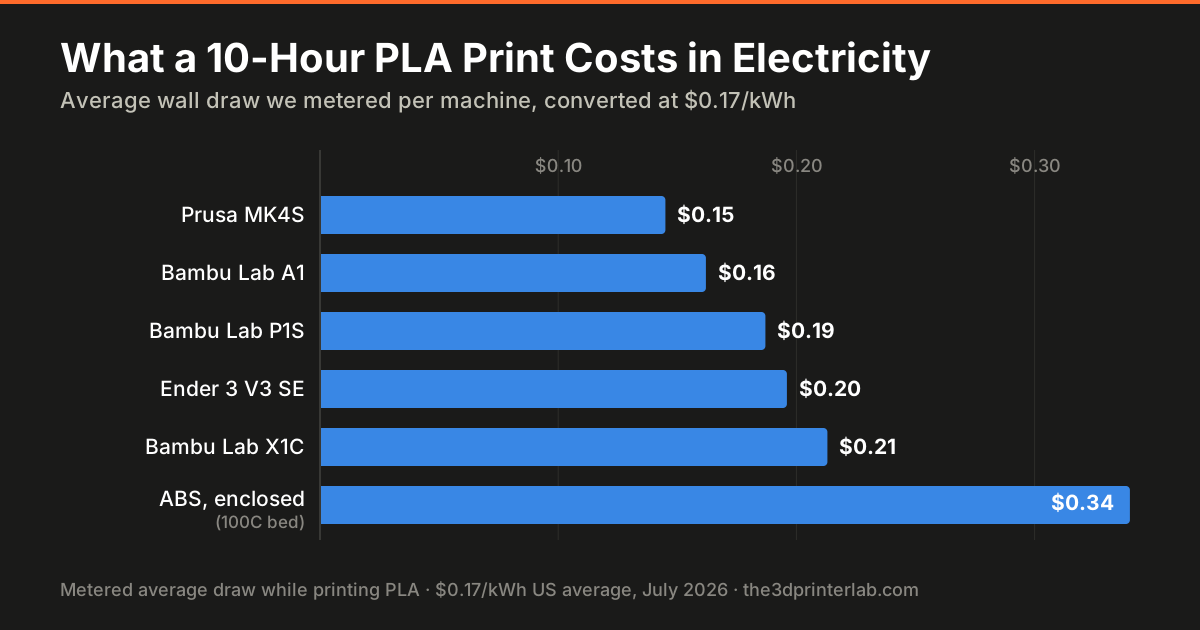
Electricity: $0.31. We metered this properly in our electricity cost deep-dive: a typical PLA print averages 120 to 180 watts once the bed finishes its initial heat. Call it 10 hours at an average 180 W with heat-up included: 1.8 kWh at the current US residential average of about $0.17/kWh is 31 cents. Enclosed high-temp printing can triple this; it is still coffee money.
Failure overhead: $0.50. Nobody’s success rate is 100%. If you honestly land around 90% (most of us do, between first layers that walked off, mid-print clogs, and the spool that ran out lying about its remaining weight), then every successful print carries a share of the failures. Ten percent overhead on the materials-plus-power subtotal is about 33 cents; we round up to 50 because failures cluster on exactly the long prints that cost the most.
Wear and consumables: $0.55. The slow eaters: brass nozzles ($3 to $8) are a consumable that wants replacing every 300 to 500 print hours, sooner with abrasive filaments. PTFE tubes, build surfaces, belts, fans, the occasional thermistor: across a busy printer these average out to roughly 4 to 6 cents per print hour. Ten hours, call it 55 cents including the nozzle’s share.
Machine depreciation (optional but honest): $1.00. A $500 printer that delivers 5,000 print hours before it is retired or rebuilt costs 10 cents per hour of its own existence. Our 10-hour print carries a dollar. Hobbyists can ignore this line; anyone charging money cannot.
Total: about $5.36 with depreciation, $4.36 without. Against the naive “three bucks,” the true number is 45 to 79 percent higher.
The Reusable Formula
For any print, in any material:
Cost = (grams x price-per-gram) + (hours x watts x rate / 1000) + 10% failure overhead + (hours x $0.05 wear) + (hours x depreciation rate)
Two rules of thumb fall out of this for a typical PLA setup at 2026 prices:
- Hobby math: filament cost + about 10 cents per print hour covers power and wear.
- Pricing-for-others math: filament cost + about 20 cents per print hour, then multiply the whole thing by at least 3 for your time, or you are running a charity with extra steps.
Where the Money Actually Hides
Working through this taught us three things worth passing on.
Cheap filament is expensive when it fails. The $13 mystery spool that clogs once per roll does not just cost a nozzle-cleaning session. One failed 10-hour print burns more money in wasted filament, power, and wear than the $7 you saved buying it, before counting your evening. Mid-tier name-brand filament with tight diameter tolerance is the correct value pick for anything you care about, which is the same conclusion our beginner filament guide reached from the quality direction.
Print time is nearly free; failed print time is not. Since power and wear together run around a dime an hour, slowing a print down by 20% for reliability costs pennies while a failure costs dollars. When a part matters, the slower profile is the economically rational one, which is a lovely excuse to stop chasing speed benchmarks.
Abrasives change the equation. Carbon-fiber and glow filaments chew brass nozzles in tens of hours, not hundreds. A hardened steel nozzle ($15 to $30) turns that line item back into a rounding error and pays for itself within two or three spools of the fancy stuff. If you run abrasives on brass, your wear line is 3 to 5 times ours.
So Is 3D Printing Cheap or Not?
Cheap. Genuinely, boringly cheap. The complete, honest, everything-included cost of a substantial 10-hour print is about the price of a fancy coffee, and a little benchy-sized job runs well under a dollar. The point of doing the math is not to discover a hidden expense; it is to price fairly when someone asks you to print something, to recognize that reliability upgrades pay for themselves, and to win the argument when someone in the house claims the printer is “expensive to run.” It is not. We have the spreadsheet.
Sponsored
Ready to Print?
Browse our guides for more tips on getting the best results from your printer.
Browse All GuidesReady to Print?
Browse our guides for more tips, reviews, and step-by-step tutorials to get the most out of your 3D printer.
Browse All Guides