 Materials
Table of Contents
PETG vs PLA: When Each Filament Actually Beats the Other
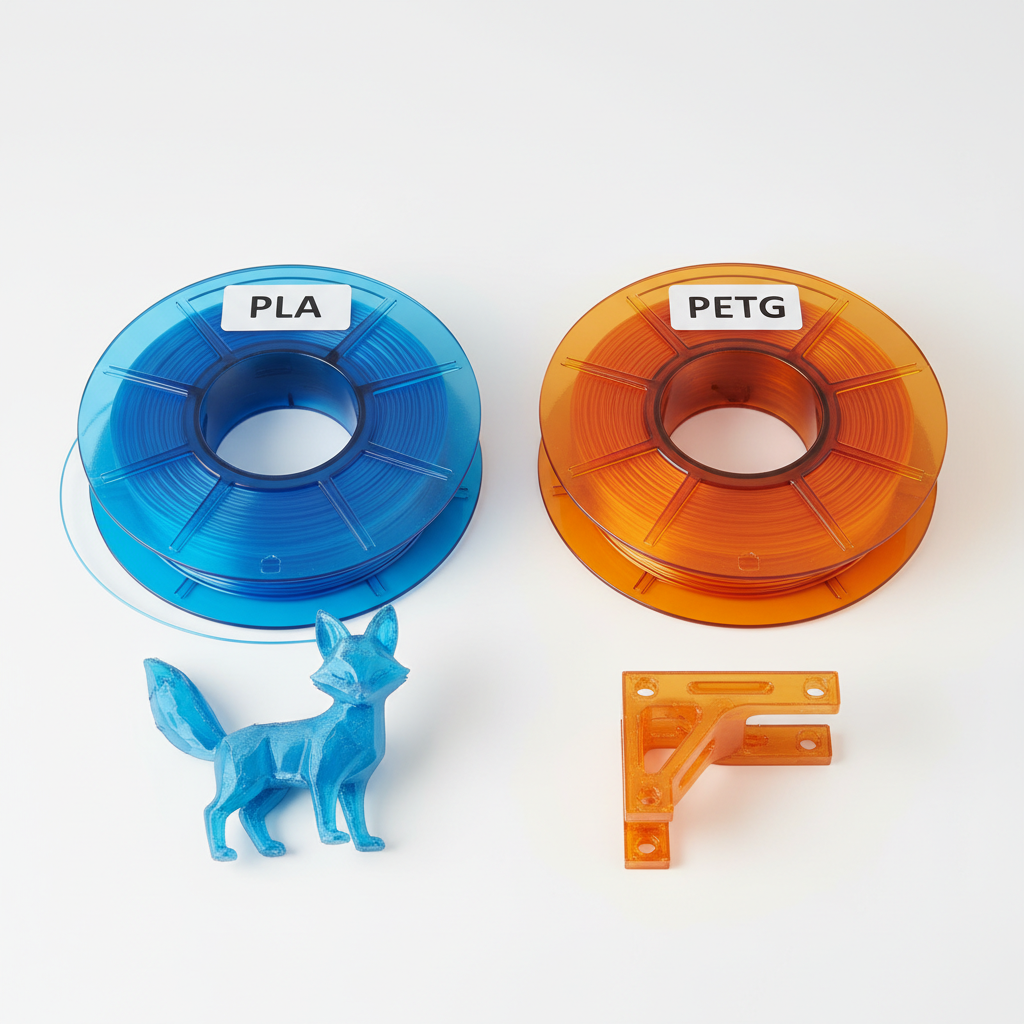
If you’ve been printing for more than a couple months, you’ve heard the basic comparison: PLA is easy, PETG is tough. That’s true, but it’s a useless oversimplification. The real question is which one will actually work for the print in front of you - and the answer depends on a half-dozen things most filament guides skip.
Here’s a practical breakdown based on what we actually print and what fails in the real world.
Temperature Resistance
This is where PLA falls apart, sometimes literally. PLA starts to soften around 140°F (60°C). That’s well within range of:
- A car dashboard or anything in a parked car in summer
- An attic in July
- The top of a dishwasher during a heat-dry cycle
- A garage in direct sunlight
PETG’s glass transition is around 180°F (80°C) - still not high, but enough to survive most of those scenarios. If your part is going anywhere warm, PETG wins by default.
If the part will face genuinely hot environments (engine bays, electronics enclosures with heat-producing components, anything that sees sustained sun on dark surfaces), neither PLA nor PETG is the right call. You want ABS, ASA, or PC.
Sunlight and UV
PLA gets brittle in sunlight. Outdoors, untreated PLA can become so fragile within 6–12 months that it breaks under hand pressure. PETG holds up much better - not bulletproof, but you’ll get years of outdoor service from a PETG part.
For anything outside, PETG is the right choice unless you’re prepared to coat the print with UV-protective spray.
Layer Adhesion and Strength
PETG has noticeably better layer adhesion than PLA. When PLA fails, it almost always fails along a layer line - clean breaks at the print direction. PETG fails more like a real plastic; it deforms, stretches, then breaks.
This matters for any part under repeated stress: hinges, clips, brackets, anything that flexes. PETG is also more impact-resistant. Drop a PLA part on concrete and it shatters. Drop the same part in PETG and it usually just dings.
That said, PLA is stiffer. For static parts that need to hold their shape under load - a tool holder, a wall mount, a bracket that bolts to something - PLA’s higher rigidity is an advantage. PETG flexes a tiny bit, which can be the wrong answer for a precision fit.
Print Difficulty
PLA prints clean on any modern printer with default settings. Bridges fine, overhangs are forgiving, supports snap off easily.
PETG is fussier. You’ll deal with:
- Stringing - PETG loves to ooze. You’ll need to dial in retraction.
- Bed adhesion that’s TOO good - PETG can rip chunks out of a PEI sheet if you don’t use a release agent (glue stick or release coat).
- Supports that fuse to the part - PETG support interfaces almost weld themselves to the model. Use Z-distance of 0.2–0.3mm or expect to spend time cleaning.
- Wet filament problems - PETG is more hygroscopic than PLA. If your spool sat out, the prints will look like garbage. Dry it.
For a beginner or a first-of-its-kind print, PLA is almost always the right place to start.
Food Contact
Neither PLA nor PETG is officially food-safe out of a 3D printer - the layer lines harbor bacteria regardless of material. But of the two, PETG is closer. The base resin is the same plastic used in soda bottles. PLA derived from corn starch can grow mold faster in moist environments.
For an occasional cookie cutter, both are fine if you wash them and don’t reuse for raw meat. For anything that contacts food repeatedly, neither is a real answer - and you should be looking at food-grade silicone molds or commercially manufactured tooling.
Cost
Effectively the same. Both are widely available for $15–$25 per kg at the consumer level. Premium brands push higher in both categories. If price is the deciding factor, PLA is fractionally cheaper at the bottom of the market - but the difference is noise.
Quick Decision Guide
| Use Case | Pick |
|---|---|
| Prototype, miniature, decorative | PLA |
| Outdoor part | PETG |
| Anything in a car or warm space | PETG |
| Functional clip, hinge, bracket | PETG |
| Fast print for a deadline | PLA |
| Mechanical part under load | PETG |
| Beginner’s first print | PLA |
| Camera mount, tripod adapter | PETG |
| Low-tolerance display piece | PLA |
The Bottom Line
If your print is decorative, fast, or for indoor display, PLA is fine and easier to live with. If it’s going outside, getting hot, getting dropped, or doing actual work - PETG wins, but you’ll need to spend a print or two dialing in your settings.
The biggest mistake people make isn’t picking the wrong filament. It’s picking PLA because it’s easy, then being surprised when the bracket on the side of their grill turns into a banana in August.
Sponsored
Ready to Print?
Browse our guides for more tips on getting the best results from your printer.
Browse All GuidesReady to Print?
Browse our guides for more tips, reviews, and step-by-step tutorials to get the most out of your 3D printer.
Browse All Guides